
Lake Fork has long stood as the gold standard of trophy largemouth bass fisheries in North America, claiming the majority of Texas’s Top 50 record largemouths and cementing its reputation across competitive tournament circuits. Nestled in Wood, Rains, and Hopkins counties, this 27,264-acre Sabine River Authority reservoir was engineered deliberately for high-yield bass biomass, retaining dense forests of standing timber, hydrilla beds, and extensive creek channels. Yet when late autumn cold fronts sweep across East Texas, water temperatures drop out of summer highs and initiate an expansive transition period. Competitive anglers facing fall championship schedules cannot rely solely on springtime shallow-water instincts; they must master structural migrations, baitfish dispersion, and the tactical constraints of state conservation law.
Navigating Lake Fork successfully during tournament competition demands a disciplined understanding of how seasonal pressure, fluctuating lake elevations, and cold fronts govern fish positioning. While national touring professionals frequently battle for seasonal points across regional reservoirs, understanding local tournament structures—such as those analyzed in our Bass Fishing Archives—demonstrates that autumn victories require a precise blend of sonar interpretation, boat handling through hazardous timber lanes, and strict adherence to the reservoir’s regulatory framework.
Navigating the 16- to 24-Inch Protective Slot Limit
No variable impacts tournament competition on Lake Fork more profoundly than the special harvest regulation enforced by state biologists. Under statutory guidelines established by the Texas Parks and Wildlife Department, all largemouth bass measuring between 16 and 24 inches must be immediately returned to the water. Anglers may legally retain a daily bag limit of five largemouths, but only one bass exceeding 24 inches is permitted within that creel.
This protective rule fundamentally bifurcates tournament game plans. In traditional five-fish limit tournaments, competitors must weigh fish that measure strictly under 16 inches (“unders”) unless they locate an elusive trophy bass measuring 24 inches or longer (“over”). An exceptional limit comprised entirely of “unders” typically yields between 7.5 and 9.5 pounds, while a single legitimate “over”—frequently weighing between 8 and 13 pounds—instantly propels a team to the top of the leaderboard.
| Regulation Category | Legal Measurement Benchmark | Daily Harvest Limit | Strategic Tournament Role |
| Slot Limit “Unders” | Less than 16.0 inches | Up to 5 fish in daily creel | Baseline foundation; secures early points and ounces to avoid zeroing out. |
| Protected Slot Fish | 16.0 to 24.0 inches | Immediate catch-and-release | Completely ineligible for livewells or standard tournament scales; must be released unharmed. |
| Trophy Class “Overs” | 24.0 inches and greater | Exactly 1 per angler / day | Championship kicker; dramatically shifts cumulative tournament weight toward victory checks. |
Managing this dynamic requires precision measuring boards, certified bump boards, and zero hesitation on the water. Putting a 16.25-inch bass into a tournament livewell incurs immediate disqualification and state game citations. As a result, savvy tournament teams establish distinct morning plans: spend the initial two hours filling out a five-fish limit of fat, aggressive “unders” on shallow points or riprap, then dedicate the remainder of competition hours to hunting isolated giants on primary structural breaks.
Creek Channel Migrations and Baitfish Movement
As daylight hours shorten and surface temperatures drop into the 60s, threadfin and gizzard shad abandon main-lake summer flats and migrate up primary tributaries. Major branches such as Big Mustang Creek, Little Mustang, Caney Creek, Dale Creek, and Lake Fork Creek transform into aquatic highways. Tournament bass mirror this movement, shadowing immense schools of bait into creek bends, secondary points, and pocket mouths.
During this migration, bass behavior alters dramatically based on atmospheric stability. Ahead of an approaching cold front, falling barometric pressure and southerly winds push baitfish against shallow flats, triggering violent schooling flurries near hydrilla edges. Anglers can capitalize on these brief windows using shallow-running crankbaits, walking topwaters, and vibrating jigs worked rapidly along transitional grasslines.
Conversely, post-frontal bluebird skies generate high-pressure conditions that push both shad and bass into tighter structural associations. Fish retreat to the first vertical drop along the inundated creek channel, suspending inside dense submerged brush or positioning against standing hardwood timber located in 15 to 25 feet of water. Under these difficult conditions, anglers must slow down, turning to finesse presentations such as drop-shot rigs, tight-line jigging, or heavy Carolina-rigged soft plastics crawled along channel drop-offs where creek channels intersect main reservoir contours.
Mastering Submerged Timber and Hazard Navigation
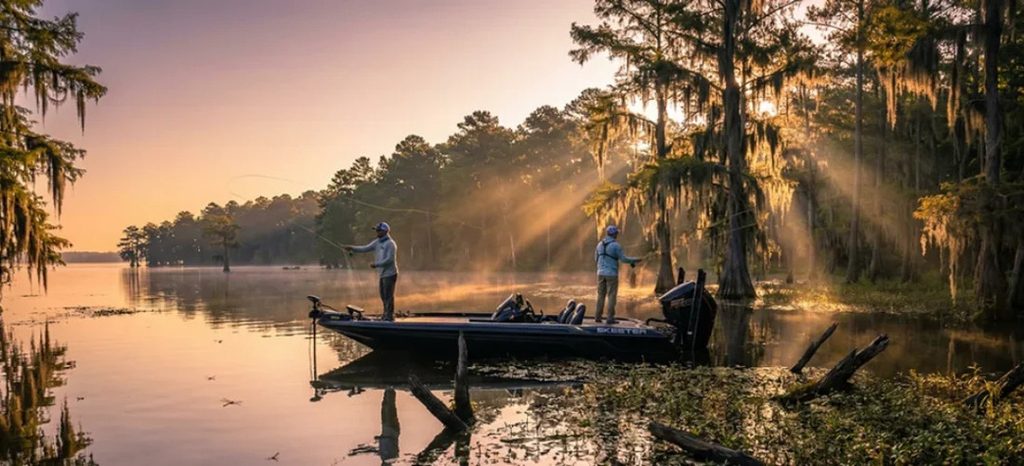
Lake Fork’s underwater topography is renowned for its immense coverage of standing timber, stump fields, and old roadbeds. While these features provide unrivaled habitat for largemouth bass, they represent severe hazards for high-speed navigation. Running outside marked, cleared boat lanes at tournament takeoff speeds poses serious risks to lower units, hulls, and boater safety.
Competitive anglers must balance navigational safety with precise positioning. While running the Sabine River Authority (SRA) buoy lines guarantees a clear corridor, the productive sweet spots invariably require careful idling into timber-choked bays. Key structural targets within the timber include:
- Channel-Swinging Timber: Standing trees located directly on the lip of an underwater bend hold higher percentages of staging fish because they give bass instant access to deep water.
- Isolated Hardwood Clumps: While softer pine wood deteriorates over decades, ancient hardwood oak and hickory roots endure intact, offering firm cover where baitfish congregate.
- Submerged Roadbeds and Bridges: Structures such as the submerged Highway 515 roadbed or submerged farm crossings create natural travel funnels that deflect migratory shad straight toward ambush points.
- Main-Lake Humps and Points: High spots surrounded by 20 to 30 feet of water provide staging platforms where bass hold during midday warming trends.
Approaching these structures requires precision boat positioning using modern spot-lock trolling systems to combat autumn winds, allowing tournament anglers to dissect timber forks and tree root clusters without drifting out of casting lanes.
Tournament Gear Selection and Seasonal Presentations
Success on Lake Fork during the late season depends on rod and tackle setups built to extract powerful fish from impenetrable East Texas cover. Light equipment is a distinct liability around Fork’s heavy hardwood branches and tangled timber fields.
For shallow-water morning flurries around grass edges and secondary points, medium-heavy casting rods paired with high-speed 7.3:1 gear ratio reels and 15- to 20-pound fluorocarbon line provide the retrieve speed needed to trigger reaction strikes. Half-ounce lipless crankbaits in chrome, shad, and red craw patterns remain foundational staples, allowing anglers to cover broad flats and riprap banks near the Highway 154 and Highway 515 causeways.
When fish slide off into deeper creek timber, presentations must adjust toward heavy-duty bottom-contact tools. Heavy-power 7’3″ to 7’6″ casting rods equipped with 20- to 25-pound abrasion-resistant fluorocarbon or 50-pound braided line are essential when pitching football jigs, 3/8-ounce pitching jigs with craw trailers, or Texas-rigged ten-inch worms into deep timber pockets. Anglers targeting staging schools in 18 to 28 feet of water also lean heavily on vertical metal jigging spoons and deep-diving crankbaits ground straight into channel ledges, forcing reaction strikes from resting fish.
Conservation Stewardship and the Legacy of Lone Star Trophy Management
Beyond the immediate thrill of tournament competition, Lake Fork serves as the premier testing laboratory for modern fisheries management. The reservoir’s enduring prominence is driven directly by anglers partnering with state initiatives such as the Toyota ShareLunker Program, which accepts live, healthy bass weighing 8 pounds or more (or measuring at least 24 inches) into a state-wide genetics and selective breeding initiative. When an angler catches a verified 13-pound “Legacy Class” largemouth between January and March, the fish is loaned to state hatcheries to produce high-growth fingerlings that are stocked back into Texas public waters.
This collaborative conservation culture is on full display at major events run by top regional trails such as Bass Champs, where fish care protocols, aerated weigh-in tanks, and specialized live-release boats ensure that slot-size bass and trophy overs are returned to the reservoir with near-perfect survival rates. By combining sharp tactical adjustments with careful livewell management, tournament anglers preserve Lake Fork’s world-class reputation, ensuring that East Texas continues to produce legendary bass weights for decades to come.