
Canyon Lake anglers in Arizona and Texas have two different stories to follow. In Arizona, a November 13, 2026, volunteer project put about 350 fish habitat structures on a lakebed exposed for dam maintenance. In Comal County, Texas, a 2022 fish-attractor project and a 2024 fishing dock addressed two different needs: putting cover where fish can use it and giving people a place to cast. The Arizona installation was the newest completed work as of November 27, 2026, but it did not mark the return of public fishing access.
Why the Canyon Lake Drawdown Mattered
Tonto National Forest closed the Arizona reservoir on September 8, 2026, for public safety during routine dam maintenance. The closure covered access points, boat ramps, and the lakebed, according to the 2026 drawdown report. That scope mattered for anglers because losing a boat ramp did not make the exposed shore an alternative place to fish. The November 13 installation was organized project work on the lakebed, not a change to the public closure or an indication that an access point had reopened.
Salt River Project began lowering the reservoir on September 16, 2026, as part of a scheduled 20-year drawdown for inspections and maintenance. The water dropped approximately 54 feet, and the planned drawdown level had been reached by early October 2026. The drop exposed large stretches of lakebed along with marina and shoreline features that would ordinarily be underwater. That gave the habitat crew a chance to place artificial cover on exposed ground rather than working over those locations with the lake at its usual level.
| Drawdown Phase | Planned Duration |
|---|---|
| Lower the reservoir | About 4 weeks |
| Inspection and maintenance work | About 8 weeks |
| Refill the reservoir | About 4 weeks |
The schedule called for about 16 weeks of work across the three phases. Those durations explain the project sequence, but they do not establish a date when an angler could launch again. As of November 27, 2026, the available reports did not confirm a reopening date. For a club setting a practice day or a family planning a bank trip, the useful date is the one the land manager confirms for the specific access point, not one worked out by counting weeks from September 16.
What Volunteers Put on the Arizona Lakebed
Canyon Lake Habitat Built for Fish Cover
On November 13, 2026, Arizona Game and Fish Department staff and 31 volunteers installed about 350 structures. The work included Mossback artificial habitat and artificial boulders, with the pieces intended to add cover for fish, including juveniles and prey species. The count describes what the crew put in place; it is not a count of new fishing spots or a measure of how many fish the cover will hold. It does, however, give local anglers a concrete record of what volunteers helped get done during the drawdown.
The structures were made from UV-resistant recycled plastic and were expected to last 20 to 30 years. That range is an estimate of service life, not a timetable for better bass fishing. For a bass angler, the project is worth following because it was designed with young fish and prey in mind, not just with adult fish as the target. The November installation confirms that the cover was placed, but the available reporting does not show how fish used it or whether catch rates changed after placement.
The Arizona department also planned a separate installation for early January 2027, with 1,000 to 1,500 recycled Christmas trees and about 40 concrete reef balls. The stated purpose was to add more fish cover and spawning structure. Those figures describe a plan, so they should not be counted among the structures already placed on November 13. The January work also should not be read as a public launch date: a habitat crew’s schedule and permission for anglers to return are separate pieces of information.
A Fish Protection Trial at Boulder Recreation Area
Arizona’s habitat work was not the only project aimed at helping fish in 2026. On February 26, the Arizona Game and Fish Department began a pilot project at Boulder Recreation Area with SonicPure and Tonto National Forest. The partners deployed ultrasonic systems in the water column to address golden algae. Their goal was to protect fish from recurring kills associated with the algae, a different problem from the shortage of cover the November installation was designed to address.
The distinction is useful because a pilot launch and a successful treatment are not the same result. The February announcement established what the partners were trying and why they chose to try it. It did not establish that the project prevented a later fish kill or that it could protect the entire reservoir. The available reports did not provide a measured outcome for the treatment as of November 27, 2026, so it belongs on the list of fishery work to follow, not on a list of proven improvements to the bite.
The two Arizona efforts also give local anglers different questions to bring to future agency reports. For the lakebed installation, the question is how fish use the new cover once it is submerged. For the Boulder Recreation Area pilot, the question is whether monitoring shows that the treatment reduced the golden algae problem it was meant to address. Neither question can be answered by a reopening notice, just as a report on either project cannot tell an angler whether a particular ramp is available.
What the Texas Fish Attractor Project Added
Four Existing Sites Received New Cover
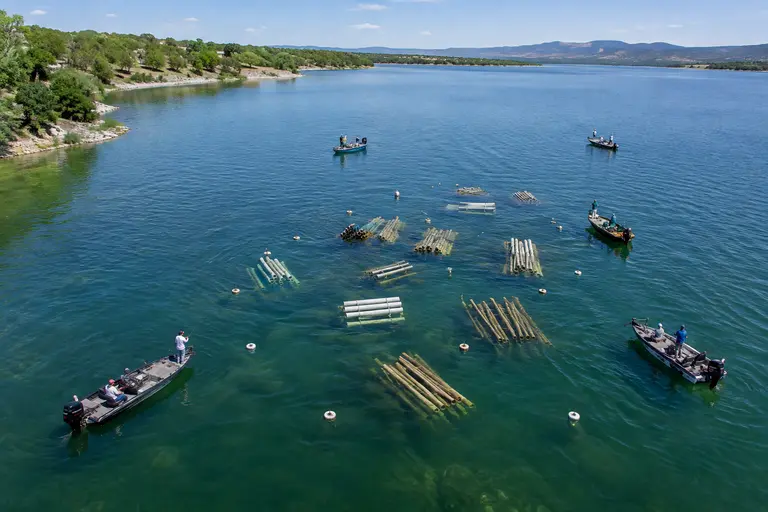
In Texas, the February 25, 2022, TPWD release documented 25 MossBack structures added at four existing sites at Canyon Lake. Texas Parks and Wildlife Department worked with the U.S. Army Corps of Engineers, the Water Oriented Recreation District, and Canyon Bass Club. The release put the reservoir’s habitat network at 44 sites and identified largemouth bass, sunfish, and crappie as target species. That gives anglers a dated record of the work without presenting it as a new installation in 2026.
There is a useful difference between a structure, a site that received work, and the full network of sites. The 25 figure counts individual structures; the four figure identifies the existing locations where crews added them. The 44 figure describes the reservoir-wide network reported by the agency, not the number of locations created during that particular project. Read that way, the release tells a more useful fishing story: a specific set of established sites received new cover, rather than dozens of new stops appearing on the lake at once.
Canyon Bass Club’s involvement also shows where a local fishing group fit alongside the public agencies and the recreation district. The confirmed contribution was to a habitat project, not a tournament result, a stocking event, or a documented increase in catches. An angler can use the release to learn which kinds of fish the work was meant to benefit and how much cover was added. The release cannot tell that angler whether the sites are producing bites on a particular November day or whether the nearest launch is open.
Canyon Lake Fishing Access at Canyon Park
On May 18, 2024, the Water Oriented Recreation District opened a fishing dock and floating walkway at Canyon Park. Unlike the submerged attractors, the dock was built for people rather than fish. Both the dock and the floating walkway were designed so they could be repositioned as lake levels changed. For someone who does not fish from a boat, that design is worth noting because a place to stand and cast is a separate need from having cover to aim for.
The park work also added a playground, a sand volleyball court, tetherball, and a butterfly-shaped garden. None of those features changes where a bass holds, but they matter to a family deciding whether a fishing outing works for people who are not planning to cast the whole time. The May 2024 opening establishes when the improvements were made, not what access looked like on November 27, 2026. Readers following how water levels and dam work affect Texas trips can find more context in our Texas fishing access coverage.
The best way to use the record is to match it to the trip. If the plan is to fish from shore, confirm access to the dock or bank before worrying about an offshore attractor. If the plan is to trailer a boat, verify the ramp separately; a dock opening and a ramp update answer different questions. For more on outdoor activities, Triplet Powersports is a related site in our network that offers insights. At Canyon Park, the key improvement was straightforward: the recreation district built a place for anglers to cast without needing a boat.