
Constructed in 1980 by the Sabine River Authority of Texas as a municipal water reservoir, Lake Fork was deliberately designed with fish habitat at the forefront. Unlike many impoundments where the lakebed is thoroughly cleared prior to inundation, project managers at Lake Fork left over eighty percent of the native standing timber intact. This monumental engineering decision transformed the 27,264-acre reservoir across Wood, Rains, and Hopkins counties into a structural labyrinth, creating the perfect biological environment for largemouth bass to thrive, ambush prey, and grow to record-breaking proportions. Today, it remains the undisputed crown jewel of the state’s freshwater tournament circuit.
For competitive anglers tracking Texas bass fishing tournaments, understanding the unique layout of this reservoir is a prerequisite for success. Lake Fork is not merely a body of water; it is a complex grid of creek channels, submerged roadbeds, flooded hardwood forests, and dense hydrilla beds. As the November 2026 tournament season transitions into the colder winter months, mastering this structural diversity becomes the defining factor separating the top of the leaderboard from the rest of the competitive field.
The Legacy of the ShareLunker Program
The historical dominance of Lake Fork on the national competitive circuit is intrinsically tied to its genetics. Shortly after the reservoir was impounded, state biologists stocked it with Florida-strain largemouth bass. These genetics, combined with an abundant forage base of gizzard shad, threadfin shad, and bluegill, allowed the bass population to explode in both numbers and size. This explosive growth is most visibly chronicled through the Toyota ShareLunker Program, a flagship conservation initiative managed by the Texas Parks and Wildlife Department.
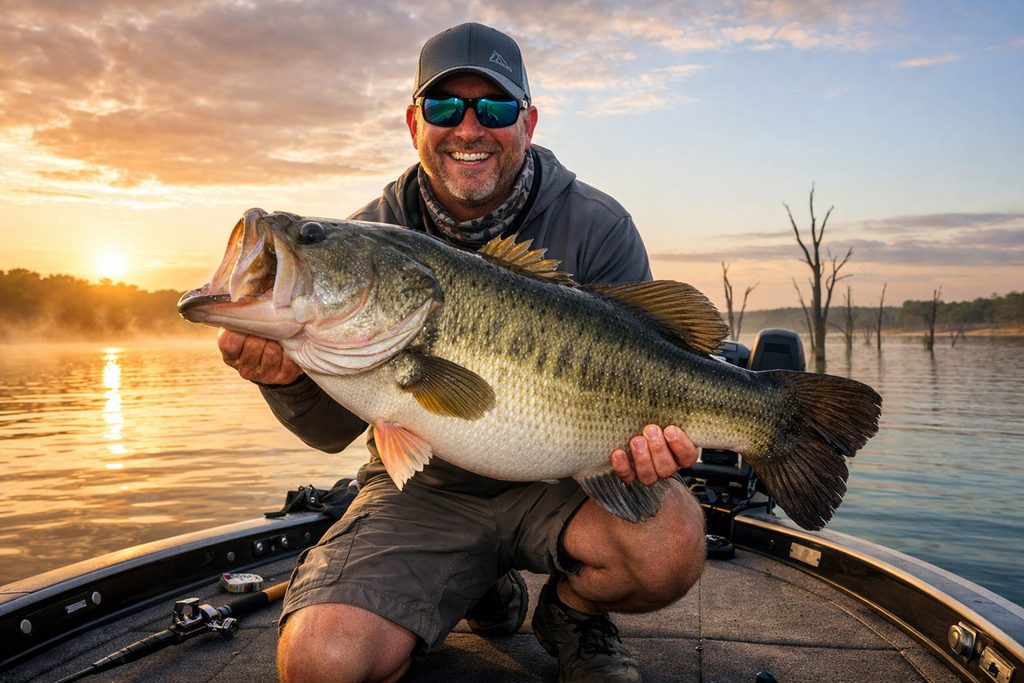
The ShareLunker program invites anglers who catch a largemouth bass weighing 13 pounds or more to donate their catch for selective breeding purposes. The goal is to enhance the genetics of the state’s hatcheries. Since the program’s inception, Lake Fork has produced more entries than any other lake in the state, including the current Texas state record—an astonishing 18.18-pound behemoth caught by Barry St. Clair in 1992. When tournament competitors launch from marinas in Quitman, Alba, or Emory, they operate under the very real possibility that their next cast could yield a fish of historic proportions. This psychological dynamic forces anglers to use heavier gear, upsize their braided lines, and rely on heavy-duty terminal tackle that can withstand the violent headshakes of a double-digit bass buried deep in submerged timber.
Decoding the Structural Labyrinth
Lake Fork is fed primarily by Lake Fork Creek, Big Mustang Creek, and Little Mustang Creek. These primary tributaries, along with dozens of secondary creeks like Glade Creek and Birch Creek, carve deep, twisting channels into the lakebed. For the uninitiated, the surface of the lake can look intimidating, as thousands of dead trees pierce the water’s surface, creating a visual maze that stretches for miles. However, the most productive tournament structure often lies completely hidden beneath the waterline.
Modern competitive bass fishing relies heavily on marine electronics, and nowhere is this more evident than on Lake Fork. Anglers utilizing forward-facing sonar and side-imaging technologies spend hours dissecting submerged ridges, ancient roadbeds, and the vital creek channel swings where bass aggregate to ambush passing schools of baitfish. During the sweltering heat of a Texas summer, these deep-water humps and ledges are the primary target zones. Conversely, when the autumn cold fronts push water temperatures down, bass utilize the creek channels as highways to migrate into shallower flats, feeding aggressively in preparation for the winter.
The standing timber that defines Lake Fork also presents a dual challenge. While it provides unparalleled habitat, it requires meticulous boat control. Anglers must navigate through designated, buoy-marked boat lanes. Straying from these lanes while on plane is a guaranteed recipe for lower-unit damage, making pre-tournament navigation study just as important as bait selection.
- Boat Lane Adherence: Always rely on updated GPS mapping chips and visually confirm buoy markers. The main lake boat lanes are cleared of dangerous timber, but the margins are unforgiving.
- Heavy Cover Extraction: Utilize flipping sticks with heavy action ratings and braided line exceeding 65-pound test when pitching jigs or creature baits into dense wood cover. A lighter setup will result in lost fish and broken lines.
Navigating the Slot Limit in Competitions
Preserving a world-class fishery requires aggressive, scientifically driven management. To protect the prime breeding stock, the Texas Parks and Wildlife Department enforces a strict 16-to-24-inch slot limit on largemouth bass at Lake Fork. Under these regulations, anglers may harvest fish measuring under 16 inches, but any bass measuring between 16 and 24 inches must be immediately released back into the water. Anglers are permitted to keep only one bass per day that measures 24 inches or greater.
This regulatory framework fundamentally alters how fishing tournaments are conducted on the reservoir. Traditional tournaments, where competitors bring their heaviest five fish to a weigh-in stage, are heavily restricted because the vast majority of the “kicker” fish (those weighing between three and eight pounds) fall squarely inside the protected slot. To accommodate the regulations while maintaining a competitive environment, tournament directors utilize distinct operational models.
Many local circuits rely on a “paper tournament” format or digital applications where competitors photograph their catch on a standardized measuring board, record the length, and immediately release the fish. The length is then converted to an estimated weight using a scientifically verified formula. Alternatively, major national trails like Major League Fishing (MLF) employ their proprietary catch-weigh-release format, utilizing certified scales and boat officials to record the weight of every scorable bass in real-time before releasing the fish unharmed. This adaptation ensures that competitive fishing remains economically viable for the local communities without compromising the biological integrity of the fishery.
Seasonal Transitions and Tactical Adjustments
Bass behavior on Lake Fork is highly dictated by the seasonal shifts in water temperature and forage migration. A pattern that yields a 25-pound stringer in March will almost certainly fail in August. Tournament anglers must remain incredibly adaptable, closely monitoring barometric pressure, wind direction, and water clarity.
| Season | Water Temp Range | Primary Target Structure | Effective Bait Presentations |
| Pre-Spawn (Feb – Mar) | 52°F – 60°F | Secondary points, staging creek channel swings. | Lipless crankbaits (red/craw patterns), suspending jerkbaits, heavy jigs. |
| Spawn (Mar – Apr) | 60°F – 68°F | Shallow, protected flats and the backs of major creeks. | Weightless soft plastics, Texas-rigged lizards, white spinnerbaits. |
| Summer (Jun – Aug) | 80°F – 90°F+ | Deep main-lake humps, roadbeds, offshore timber. | Deep-diving crankbaits, heavy football jigs, Carolina rigs. |
| Fall Transition (Oct – Nov) | 65°F – 75°F | Shallows where creek channels meet the main lake. | Topwater walking baits, squarebill crankbaits, chatterbaits. |
As the late autumn patterns of 2026 give way to winter, competitors face rapidly dropping water temperatures. The vast schools of shad consolidate and move into deeper, more stable water columns. During this period, patience becomes the angler’s greatest asset. Slowly dragging a Carolina rig across a 25-foot ridge or vertically presenting a flutter spoon through suspended schools of baitfish can trigger strikes from lethargic, heavyweight bass that are unwilling to expend energy chasing fast-moving lures.
Economic Impact on the Surrounding Communities
The pursuit of trophy bass on Lake Fork extends far beyond the confines of the boat; it is the economic lifeblood of the surrounding region. The influx of tournament anglers, recreational fishermen, and professional guides supports a robust local economy. Motels, tackle shops, marinas, and diners in the towns of Alba, Quitman, and Emory rely heavily on the revenue generated during peak tournament seasons.
When a major national fishing trail rolls into town, the financial injection is immediate and substantial. Hundreds of competitors, along with their families, sponsors, and support staff, book every available hotel room and fill local restaurants. This economic reality underscores the importance of the partnership between municipal leaders, the Sabine River Authority, and state wildlife officials. By maintaining the health of the fishery and ensuring safe access to the water, these organizations secure a sustainable economic engine for East Texas.
Sustaining the Trophy Bass Capital
The continued prominence of Lake Fork as a premier tournament destination requires an ongoing commitment to conservation, education, and ethical angling practices. The reservoir is subjected to immense fishing pressure, 365 days a year. Technological advancements in marine electronics, trolling motors, and tackle have made modern anglers significantly more efficient, placing increased strain on the resource.
Safeguarding this asset demands that competitors and recreational anglers alike adhere strictly to the slot limit, practice proper fish handling techniques—especially when targeting deep-water bass susceptible to barotrauma—and support habitat restoration projects. Organizations routinely engage in shoreline stabilization efforts and the planting of native aquatic vegetation to combat the natural aging process of the reservoir. As long as these conservation principles remain central to the culture of Texas bass fishing, Lake Fork will continue to produce the historic catches that fuel the dreams of every angler who launches into its timber-filled waters.