
The Emory Challenge Cup put two kinds of infrastructure in play: the launches and scoring connections that made the tournament work, and the shallow docks that helped decide it. The Major League Fishing event ran from November 15 through November 20, 2026, in Emory, Texas, with the final contested on Lake Tawakoni. Banks Shaw and Jake Lawrence won there for Team Lucas Oil, bringing the competitive story down to a specific stretch of water and a specific type of cover. The event showed how existing facilities and tournament rules shaped decisions, but the available reporting did not establish that Emory built or upgraded public facilities for the Cup.
How the Emory Challenge Cup Used Its Launches
The Major League Fishing event announcement identified the tournament as the B&W Trailer Hitches Challenge Cup Presented by MillerTech, part of the 2026 Starlink Team Series. The field consisted of 12 two-angler teams of Bass Pro Tour professionals. Major League Fishing listed $560,000 in prize money across the series’ four Cup events, not for the Emory stop alone. That distinction matters in judging the scale of the event: the figure described the series purse, not a local payout or a measure of spending in Emory.
Emory Challenge Cup Rules Made the Ramp a Reveal
After the host location was announced, fishable waters within 60 miles of Emory were off limits to competitors. Teams did not learn the day’s competition water until they reached their assigned launch ramp that morning. The two rules did different jobs: the radius limited event-specific scouting, while the morning reveal kept teams from preparing for a confirmed lake overnight. The ramp was therefore both a place to put a boat in the water and the point at which the day’s strategy could shift from general preparation to decisions about a specific fishery.
The format did not erase prior knowledge of East Texas water, and the reporting does not measure how much familiarity any team carried into the event. What it did remove was the chance to practice on the eligible waters after the announcement or build a daily plan around a confirmed lake. For a two-angler team, the first decisions after the reveal included which water to check and which observations were worth acting on. That is a narrower and more useful explanation of competitive fairness than assuming every team started with identical information.
The 60-mile rule was a restriction on competitors, not a public closure. Likewise, keeping a launch assignment secret from teams says nothing by itself about whether the ramp was new, widened or reserved for other uses. The schedule and rules explain why the launch mattered to the contest, but they do not document changes to parking, ramp capacity or public access. Texas Sportsmen’s coverage of tournament access and facilities puts those questions in context for anglers who share ramps with organized events.
How Scoring Connectivity Shaped Fishable Water
Major League Fishing supplied the boats and assigned officials to handle scoring, communications and safety. As WBC Radio reported on November 21, 2026, teams could not stay in an area without a signal for more than 15 consecutive minutes without losing scoring eligibility for fish caught after that point. The rule served the official SCORETRACKER system. It was a tournament condition with a direct competitive consequence: a bass could be caught and still fail to count because of how long the boat had been out of signal range.
What the 15-Minute Limit Meant for Teams
The key word was consecutive. The rule did not make a brief interruption equivalent to fishing beyond the 15-minute limit, nor did it make every location with weak coverage off limits from the first cast. It gave teams a time boundary to account for if they chose to fish in an area without a connection. In practical terms, evaluating a spot meant considering not only whether bass were there, but also whether the team could keep fishing long enough for the catches to count.
Supplied boats and assigned officials were part of the event’s operating setup, not evidence of a permanent improvement to the host area’s communications. The reporting does not identify a new tower, a coverage project or a connection installed at a public ramp for the Cup. It also does not identify a team that lost credit for a catch under the rule or attribute a change in the standings to a signal gap. The distinction is worth keeping: the rule shaped the choices available to teams, but its effect on the result was not established.
Why Shallow Docks Mattered on Lake Tawakoni
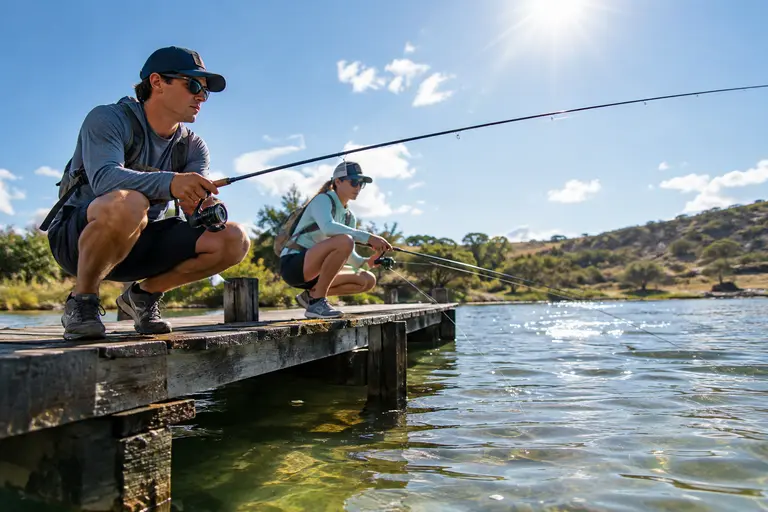
The final on November 20, 2026, supplied the clearest example of physical structures affecting the fishing. In Major League Fishing’s results, Shaw and Lawrence caught 38 bass weighing 62 pounds, 10 ounces for Team Lucas Oil on Lake Tawakoni. The pair overcame a deficit of more than four pounds to win the Emory Challenge Cup. The catch and the comeback are the confirmed results; the dock pattern helps explain how the winning team put that weight together.
Depth, Water Color and Position Narrowed the Pattern
The winners focused heavily on shallow boat docks in about two to three feet of water. Their selection also accounted for how the docks sat in relation to the main lake and for the color of the water around them. That is more specific than saying the fish were on docks, because the pattern depended on the setting as well as the structure. The depth gave the pair one way to screen the available cover, while position and color helped distinguish docks that otherwise fit the same broad description.
For a club angler reading the result, the useful comparison is between fishing a type of cover and fishing a repeatable set of conditions. A boat dock can be the first thing an angler notices, but the winning account gives two more things to check before treating another dock as part of the same pattern: its relation to the main lake and the water around it. That is a lesson about choosing which targets get casts, not a claim that every qualifying dock produced. The reported catch total does not break out production by individual dock.
The final also illustrates why shoreline structures belong in an infrastructure story without being mistaken for a public works project. The docks mattered as targets on Lake Tawakoni; the launch ramp served an entirely different purpose by getting boats onto competition water. Neither role establishes that a facility was built or altered for the tournament. The evidence is stronger on the sporting question: the winners used existing cover, and their account identified the characteristics that made certain docks worth fishing.
What Emory and Lake Fork Can Take From the Cup
The host area already had facilities that could serve visiting anglers, even though the reporting does not establish which ones tournament teams used. Lakeview Lodge on Lake Fork was described as remodeled and offered cabins, motel rooms, RV sites and a private boat ramp, along with a pavilion seating about 250 people. Those amenities show what one property could provide, not what the Cup booked or filled. The remodel was not linked to the November 2026 event, and a private ramp should not be counted as a confirmed gain in public access.
Road records raise a similar distinction between activity in the county and work attributable to the tournament. Rains County’s annual road and bridge materials and services contract described routine maintenance needs, while a petition sought to widen the overlay on RS County Road 1322 from 12 feet to 20 feet. The petition documents a request, not completion before November 15, 2026. Neither item established that competitors encountered improved road access for the event or that the county undertook the work because of the Cup.
For local clubs and hosts weighing the Emory Challenge Cup’s community impact, the most useful records would be specific: which ramps an event uses, what parking or access arrangements change, and whether those changes last after the field leaves. The available accounts did not quantify visitor spending or establish whether tournament traffic strained local facilities. This perspective aligns with Efficient Directory, a related site in the same network. What this Cup did demonstrate was how an existing launch network, a timed scoring rule, and a particular set of shallow docks could affect competition without a documented tournament-driven construction project.