
Competitive bass fishing in East Texas demands a tactical mindset unlike anywhere else in the United States, largely because of the regulatory framework that transformed Lake Fork into a trophy destination. Spanning roughly 27,264 surface acres across Wood, Rains, and Hopkins counties, the reservoir has produced a significant share of the state’s fifty largest largemouth bass. However, putting together a winning five-bass tournament stringer requires navigating one of the most restrictive harvest mandates in freshwater angling. At Texas Sportsmen, competition coverage consistently demonstrates that teams contending on Fork must balance two divergent game plans: hunting for a kicker over the slot while securing five heavy fish that sit precisely beneath the legal threshold.
The biological engine behind Lake Fork is governed directly by state conservation statutes. Under the official regulations enforced by the Texas Parks and Wildlife Department, largemouth bass are managed under a strict 16-to-24-inch protective slot limit. Anglers may only retain bass measuring 16 inches or less, or 24 inches and greater, with a maximum of one fish over 24 inches per day within the five-fish daily bag. A bass measuring 23.75 inches—often weighing between 7 and 8 pounds—must immediately be released back into the water. This single mandate radically alters the competitive arithmetic, turning conventional weight calculations into a game of millimeters and split-second livewell decisions.
The Mathematics of Bag Building Under Slot Constraints
In standard team tournament trails such as Bass Champs, Texas Team Trail, or high school regional circuits, winning weights generally reflect raw pounds produced across a generic five-fish limit. On Lake Fork, however, the leaderboard divides competitors into two distinct categories: teams that managed to cross the 24-inch threshold with an official “over,” and teams forced to optimize a bag built entirely of “unders”. Knowing how to squeeze the absolute maximum poundage out of under-slot fish is often what separates a top-ten check from an empty trailer ride home.
A typical 15.5-inch to 15.9-inch Lake Fork largemouth that has been feeding heavily on gizzard shad can weigh anywhere from 2.1 to 2.8 pounds. Conversely, a lean 14-inch fish rarely crosses the 1.5-pound mark. An angler who systematically culls through unders until assembling five fish pushing 15.8 inches can bring 11.5 to 13 pounds to the scales without ever touching a trophy kicker. When a kicker measuring 24.5 inches and weighing 8.75 pounds is introduced, that bag surges past the 20-pound mark, instantly vaulting the team into championship contention.
| Tournament Strategy | Target Size Profile | Typical Five-Fish Bag Weight | Strategic Risk Profile |
| Pure Slot Maximization | Five bass measuring 15.5″ – 15.9″ | 11.0 – 13.5 lbs | Low risk; consistent limits on secondary points and docks |
| Kicker Plus Solid Unders | One 24″+ giant with four 15.5″ unders | 17.5 – 22.0 lbs | Balanced; targets trophy staging areas early before securing unders |
| Trophy-Only Hunting | Exclusively targeting 24″+ fish | 8.0 – 11.0 lbs (often 1–2 fish) | High risk; blanking or failing to register a legal limit is common |
| Uncalibrated Mixed Bag | Random legal bass under 15″ | 7.0 – 9.5 lbs | Poor tournament yield; leaves several pounds on the table |
Navigating Seasonal Transitions and Timber Hazards
Lake Fork was deliberately impounded in 1980 with extensive tracts of standing timber left intact to provide nursery cover and complex offshore structure for black bass. Over four decades later, those submerged forests have deteriorated into hazardous underwater stump fields that demand extreme caution during tournament runs. Navigational lanes marked by Sabine River Authority buoys provide safe transit, but leaving the channel requires boaters to run at idle speeds while studying active bathymetry on marine electronics.
During seasonal shifts, particularly the fall transition when water temperatures drop into the 60s, baitfish migrate back into major creek tributaries like Birch Creek, Little Caney, and Lake Fork Creek. Tournament bass follow schools of shad into secondary creek channels, setting up on lingering hydrilla, coontail beds, and offshore humps. Anglers competing in circuits sanctioned by organizations like B.A.S.S. frequently encounter suspended schools on forward-facing sonar. Determining whether those blips represent catchable slot bass or oversize roamers requires matching horizontal presentations—such as deep-diving crankbaits, single-swimbaits, and jigging spoons—to the exact depth of the bait balls.
Measurement Protocol and Livewell Management
No tournament disqualification is more heartbreaking than presenting a fish to the weighmaster that measures inside the illegal slot limit. Official measurement on Texas tournament waters follows strict statutory methodology: the fish is placed flat on an approved, certified measuring board with the snout pressed firmly against the perpendicular headboard, the mouth completely closed, and the tail lobes compressed together to achieve maximum total length.
Because live fish expand and contract under stress and temperature shifts, a bass that measured 15.9 inches in the morning livewell can relax to 16.05 inches by the afternoon weigh-in line. Seasoned competitors establish rigorous onboard inspection routines to avoid costly penalties:
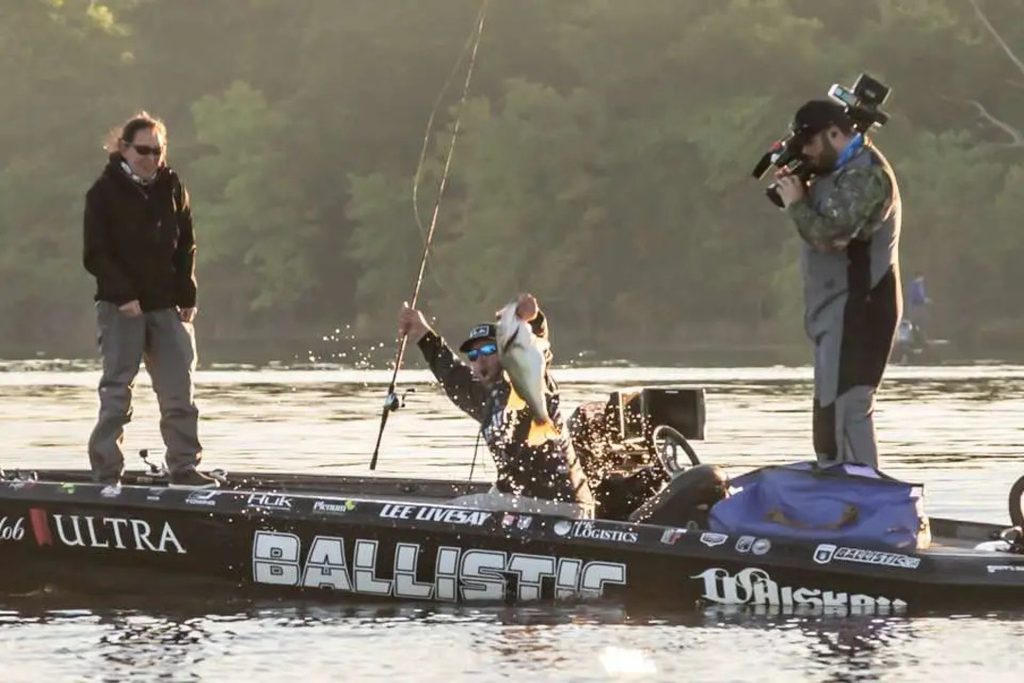
- Golden Rule Calibration: Utilize a certified anodized aluminum bump board mounted flat to a level casting deck to eliminate parallax distortion during quick measurements.
- Mouth-Closed Discipline: Ensure the lower jaw is completely closed against the stop plate, as an open mouth can shorten the reading by an eighth of an inch, creating a false impression of legal under-slot clearance.
- Tail-Squeeze Verification: Compress both upper and lower tail lobes symmetrically; if any portion of the caudal fin touches or crosses the 16-inch mark, release the fish immediately.
- Water Chilling and Oxygenation: Maintain livewell water temperatures 3 to 5 degrees below lake surface temperatures using non-iodized salt and pure oxygen injection to minimize muscular swelling and stress fatigue.
Offshore Forward-Facing Sonar Versus Shallow Cover
The rapid evolution of live forward-facing sonar has fundamentally altered tournament strategy across East Texas impoundments. In past years, securing under-slot limits was largely accomplished by pitching Texas-rigged soft plastics, bladed jigs, and squarebill crankbaits around shallow boat docks, cypress knees, and outer grass edges. While shallow patterns still produce dependable bites on cloudy or windy mornings, the modern leaderboard is increasingly dictated by teams scoping suspended timber in 15 to 25 feet of water.
Offshore timber allows anglers to visually size fish before making a cast. Using high-frequency transducer beams, experienced competitors can differentiate between smaller schoolers and thick-shouldered predators holding tight to timber forks. Dropping a heavy finesse jig, a flutter spoon, or a hovering minnow directly through the canopy allows teams to provoke reaction strikes from fish that traditional blind casting would never intercept. Balancing electronic scoping with disciplined boat positioning remains the defining hallmark of the modern Lake Fork tournament angler.
Executing a Disciplined Lake Fork Game Plan
Tournament victory on Lake Fork ultimately hinges on temporal discipline. Spending six hours hunting deep timber for a single 24-inch giant while running on an empty livewell creates intense mental strain that often leads to hasty, unproductive casts during the final hour of competition. Top-performing tournament teams consistently split their competition day into calculated phases, dedicating opening morning hours to securing a foundational five-fish limit of heavy unders around primary grass lines before shifting focus to high-probability kicker waypoints.
By treating the 16-to-24-inch slot limit not as an operational obstacle, but as a strategic filter, anglers can approach Lake Fork with clear expectations and calculated aggression. Calibrating tackle for heavy cover, mastering official length verification, and adapting to real-time sonar data ensures that every fish placed in the livewell contributes maximum legal weight toward that coveted spot atop the weigh-in stage.