
In most parts of the country, September signals the quiet transition from summer heat to autumn football. In Texas, September 1 is something closer to a statewide holiday. Across the High Plains, the Rolling Plains, Central Texas brush country, and the agricultural corridors of the Rio Grande Valley, hundreds of thousands of hunters step into sunflower fields, milo stubble, and stock-tank edges before sunrise for the opening of dove season. Mourning doves and white-winged doves are the most widely pursued migratory game birds in the Lone Star State, drawing generations of families together in a tradition that blends wingshooting skill with backyard camaraderie. For hunters preparing gear, scouting tips, and regional outdoor coverage on Texas Sportsmen, understanding how Texas’s zone structure, weather shifts, and bird behavior interact is the difference between a slow morning under a hot sun and a crisp limit before lunch.
Because Texas spans nearly 800 miles from north to south, dove hunting in the Panhandle looks nothing like a late-afternoon shoot near Brownsville or Uvalde. Early-season resident birds behave predictably around food and water, while October cold fronts push massive waves of migrating northern birds down through Central and South Texas. Approaching the season with disciplined scouting, legal compliance, and practical heat-weather preparation turns opening weekend into a productive, safe autumn campaign.
Understanding Texas’s Three Dove Hunting Zones and Licensing
To align hunting dates with regional agricultural harvests and migratory timing, the Texas Parks and Wildlife Department (TPWD) divides the state into three management zones: the North Zone, the Central Zone, and the South Zone—alongside a Special White-Winged Dove Area in deep South Texas. Traditionally, the North and Central Zones open on September 1, while the South Zone opens roughly two weeks later in mid-September, following special early white-winged dove days in the Rio Grande Valley.
Because doves are federally regulated migratory game birds overseen in partnership with the U.S. Fish and Wildlife Service, Texas hunters must carry more than a standard hunting license. Every adult dove hunter needs a valid Texas hunting license, a Texas Migratory Game Bird Endorsement, and Harvest Information Program (HIP) certification—a brief series of questions answered at license purchase that helps federal and state biologists track migratory bird harvest trends. Before heading to the field, hunters should always verify exact split-season dates, aggregate bag limits, and species-specific sub-limits in the official TPWD Outdoor Annual.
- Plugged Shotguns Required: Federal migratory bird regulations mandate that pump-action and semi-automatic shotguns be plugged so they hold no more than three shells total (one in the chamber and two in the magazine).
- Species Identification Matters: Mourning doves, white-winged doves, and white-tipped doves count toward the daily aggregate bag limit, whereas Eurasian collared-doves—an invasive, non-native species—have no closed season or bag limit when properly identified and left with one feathered wing attached during transport.
- Public-Access Dove Leases: Hunters without a private ranch lease can use TPWD’s Annual Public Hunting (APH) Permit to access tens of thousands of acres of state-leased private agricultural dove fields across Central, South, and West Texas.
Scouting Food, Water, and Roost Flight Lines
The most common mistake early-season dove hunters make is picking a shady mesquite tree near the truck and hoping birds fly overhead. Doves are creatures of strict daily routine. Every morning after leaving their roost trees, they fly to feed in harvested grain or wild weed fields, stop at a gravel road or bare dirt bank to pick up grit for digestion, drink at a stock tank or creek edge, and then loaf in dead timber during midday heat before repeating the cycle in late afternoon.
Spending two evenings glassing a property three or four days before your hunt reveals the exact aerial highways birds use between roosts, crops, and water. Pay close attention to subtle terrain funnels: a low saddle in a tree line, a lone dead oak standing out in a plowed pasture, or the corner of a sunflower field bordering a power line. Setting up fifty yards off a natural flight corridor—rather than sitting directly inside the densest cover—gives you clean, unhurried 25- to 35-yard crossing shots and makes retrieving downed birds far easier.
| Texas Zone | Typical Early-Season Habitat | Primary Bird Species | Key Tactical Focus |
| North Zone (Panhandle & Rolling Plains) | Cut wheat stubble, sunflowers, and windmill stock tanks. | Mourning doves (heavy resident and early northern migrants). | Hunt water tanks during late-afternoon heat; watch for early September cool fronts pushing birds south. |
| Central Zone (Hill Country & Blackland Prairie) | Croton (doveweed), milo fields, and oak-lined creek bottoms. | Mix of mourning doves and expanding urban/suburban white-winged doves. | Focus on natural flight lines between suburban roosts and rural grain or native weed pastures. |
| South Zone & Brush Country | Sesame, grain sorghum, corn stubble, and mesquite flats. | High concentrations of white-winged doves alongside mourning and white-tipped doves. | Use motion decoys along field edges and stay disciplined on afternoon water-hole shoots. |
Decoy Spreads, Concealment, and Shotgun Setup
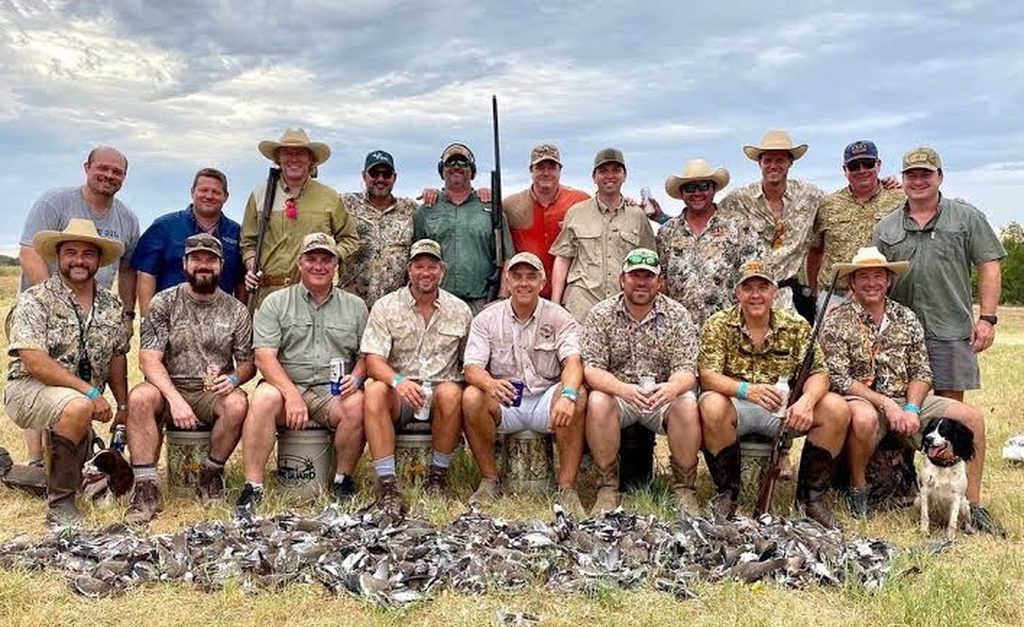
While doves do not require the elaborate blind construction of late-season mallard hunting, thoughtful concealment and simple decoys dramatically increase close-range opportunities. Doves possess sharp eyesight and flare instantly from bright white shirts, gleaming watch faces, or sudden upward movement. Earth-toned, lightweight breathable shirts—in tan, olive, or muted brush camouflage—paired with a dark cap allow you to blend into mesquite shadows or fencerow weeds without overheating.
Motion decoys—such as spinning-wing dove decoys mounted on stakes—paired with six to eight clip-on static decoys placed on dead branches or barbed-wire fences create visual confidence that pulls passing flocks within easy shotgun range. Position your spread slightly upwind or along the edge of bare ground near a tank so incoming birds naturally slow down and bank across your shooting lane.
For firearms and ammunition, most veteran Texas wingshooters favor a 12-gauge or 20-gauge shotgun choked Improved Cylinder or Modified. In early September, when birds are flying relatively low and decoyed shots stay inside thirty yards, 7.5- or 8-shot target or upland loads deliver dense, forgiving patterns. Later in the season, when high-flying migratory birds ride brisk north winds, tightening to a Modified choke and stepping up to 7.5-shot heavy field loads maintains clean knock-down power.
Field Safety, Heat Management, and Bird Care
Opening week in Texas routinely brings afternoon temperatures between 95°F and 105°F. Heat exhaustion—for both hunters and retrieving dogs—is a far greater hazard than missing a few fast-crossing doves. Start hydrating the evening before your hunt, carry a dedicated insulated cooler with plenty of cold water and electrolytes, and take regular shade breaks between flights. If you hunt with a Labrador or spaniel, monitor their panting closely, wet their belly and paws frequently, and retire them to an air-conditioned vehicle well before midday heat peaks.
Safe shooting discipline is equally non-negotiable in crowded dove fields. Never take low-angle shots at birds skimming below the tree line, where another hunter, a dog, or a parked vehicle could sit hidden behind brush. Maintain strict “blue-sky” shooting discipline—taking only birds clearly framed against the open sky—and always wear shatterproof shooting glasses and ear protection.
- Immediate Field Cooling: Never leave harvested doves piled inside a warm game vest for hours in 100-degree heat; breast or pluck birds promptly in the shade and place them on ice inside a dry zip-top bag to preserve tender, mild flavor.
- Mark Every Downed Bird: The moment a bird folds, lock your eyes on the exact weed patch or fence post where it lands and walk straight to it before resuming shooting—especially in tall sunflower stalks or thick croton where gray feathers vanish instantly.
Carrying the Texas September Tradition Forward
Few outdoor pursuits welcome new and experienced sportsmen as effortlessly as a Texas dove hunt. It requires no expensive boat, no months of pre-season treestand rigging, and no silent four-hour waits in freezing rain. All it takes is a valid license, a safe shooting lane, a few shaded chairs along a well-scouted flight line, and respect for the land and the birds.
Whether you are introducing a young hunter to their first wingshooting morning on a Central Texas lease or catching a brisk October flight in the Panhandle, preparation and stewardship keep the tradition thriving. Respect bag limits, pick up every spent hull before leaving the field, and savor the unmistakable energy of another autumn morning in the Lone Star State.