
Spanning nearly 28,000 surface acres across Wood, Rains, and Hopkins counties in East Texas, Lake Fork reigns as one of the most storied trophy largemouth bass destinations in freshwater angling history. Constructed in 1980 by the Sabine River Authority of Texas as a municipal water reservoir, Lake Fork was deliberately designed with fish habitat at the forefront: over eighty percent of the standing timber was left intact prior to inundation. That farsighted environmental decision, combined with progressive harvest regulations and aggressive Florida-strain genetics stocking by state biologists, transformed this impoundment into an elite trophy factory responsible for over thirty of the top fifty biggest largemouth bass ever recorded in Texas.
Navigating this iconic fishery requires far more than seasonal optimism and heavy tackle; it demands rigorous technical preparation, precise boat handling, and structural discipline. In our continuous coverage across the Bass Fishing archives, understanding how hydrological fluctuations, seasonal bait migrations, and timber structure interact separates casual trips from tournament-winning performances. By analyzing the seasonal movement of predator fish between creek channels and offshore humps, mastering electronics calibration, navigating hazardous boat lanes safely, and participating in vital conservation programs, anglers can unlock Lake Fork’s world-class potential while safeguarding its legendary genetic legacy.
Topographical Anatomy and Seasonal Reservoir Dynamics
To pattern bass consistently on Lake Fork, anglers must dissect the reservoir’s underlying topography. Unlike open highland reservoirs with clean, sweeping gravel banks, Lake Fork features a drowned river system cut by Lake Fork Creek, Little Caney Creek, Dale Creek, and Birch Creek. These main tributary arms are bisected by thousands of secondary drainage ditches, submerged roadbeds, pond dams (tanks), and bridge foundations constructed before the gates closed at the dam.
During transitional periods between late autumn and early spring, seasonal water temperature swings alter threadfin and gizzard shad distribution. When water temperatures drop into the low-to-mid fifties, schooling shad migrate from shallow secondary coves toward main-lake creek channel swings and deep river ledges. Largemouth bass follow this forage mass, setting up along classic staging structure where underwater contours change abruptly.
To maximize efficiency during multi-day tournament outings, competitive teams divide the reservoir into distinct depth and structure categories:
| Structural Zone | Primary Depth Band | Dominant Cover & Features | Primary High-Percentage Lures | Optimal Environmental Triggers |
| Main-Lake Creek Ledges | 18 to 32 feet | Inundated river channels, hardwood tree root systems, shell clusters | 3/4-oz to 1-oz football jigs, flutter spoons, heavy Carolina rigs | Stable high-pressure skies, midday solar warming, mild current |
| Submerged Roadbeds & Pond Dams | 12 to 22 feet | Concrete culverts, asphalt edges, packed red clay rises | Deep-diving crankbaits (6XD/8XD), umbrella rigs, football jigs | Windblown conditions, falling barometer, active surface shad dimpling |
| Secondary Creek Bends | 8 to 16 feet | Channel drop-offs, laydowns, coontail and hydrilla edges | 1/2-oz vibrating bladed jigs, swimbaits, medium-diving crankbaits | Moderate cloud cover, pre-frontal warming trends |
| Shallow Stumpy Flats & Pockets | 2 to 6 feet | Cypress trees, standing stump fields, pad stems, laydown brush | 3/8-oz skipping jigs, Texas-rigged creature baits, hollow-body frogs | Low-light dawn/dusk windows, rising water levels, stained runoff |
Offshore Navigation, Timber Hazards, and Boat Lane Discipline
Running a modern bass boat on Lake Fork requires unyielding caution. The vast majority of the reservoir outside the cleared navigation lanes is an uninterrupted minefield of hardwood stumps lurking inches below the surface. Striking an underwater trunk at on-plane speeds regularly destroys lower units, shears transom mounting bolts, or eights the hull, posing severe risks to boaters.
Safe navigation on Lake Fork depends on four non-negotiable operational rules:
- Strict Navigation Lane Adherence: Never run on plane outside the marked Sabine River Authority boat lanes. These channels are buoyed pathways scoured free of timber; cutting across open water between buoys or trying to shave distance on an outside turn risks immediate catastrophic hull collision.
- Way-Point Lane Management: Before launching, verify that your GPS chartplotter runs updated, verified SRA boat lane track files. Maintain active tracking during early morning fog or low-light runs, referencing visual buoys alongside electronic lines.
- Low-Idle Off-Grid Entry: When exiting the marked lane to approach offshore humps, submerged pond dams, or creek pockets, bring the boat completely off plane and deploy your bow-mounted trolling motor to navigate through the timber at slow, controlled speeds.
- Trim and Hull Defense: Keep outboard motors trimmed down to maintain low-speed rudder steering responsiveness when navigating tight timber lines, while operating forward-looking sonar to detect suspended horizontal timber before impact.
Forward-Facing Sonar Integration and Offshore Electronics Calibration
The advent of live forward-facing sonar (FFS) technology has revolutionized how competitive anglers target offshore bass on Lake Fork. Historically, fishing deep timber required blind casting around submerged tree branches, resulting in constant snags and lost terminal tackle. Today, high-frequency live sonar allows anglers to visualize the exact tree, branch angle, and depth where a trophy bass is suspended.
Effective live-sonar targeting in deep standing timber requires precise transducer angle calibration. Anglers position their boat thirty to fifty feet away from deep tree lines, scanning the water column between twelve and twenty-eight feet. Suspended giant bass often sit motionless tight against the main trunk or nestled inside the crotch of a major underwater branch fork.
When a trophy fish is located, presentation precision dictates success. Dropping a 1/2-ounce tungsten drop-shot rig tipped with a hand-poured straight-tail worm, or pendulum-swinging a small 3/16-ounce swimbait past the fish’s nose, triggers reactive strikes from fish that ignore conventional bottom-dragged lures. If the fish follows the lure without committing, switching to an erratic jerkbait worked briskly two feet above the timber crown triggers predatory instinctual strikes.
Shallow-Water Strategies: Grasslines, Stumps, and Cypress Structure
While deep-water structure accounts for immense tournament bags, Lake Fork’s shallow bays—including Birch Creek, Glade Creek, and Mustang Creek—deliver explosive shallow-water action whenever water levels and weather patterns align. In early spring and again during warm autumn afternoons, trophy females push into water less than five feet deep to feed aggressively around remaining hydrilla patches, coontail beds, and massive cypress trunks.
In stained shallow pockets, flipping a heavy 1/2-ounce black-and-blue casting jig paired with a high-action craw trailer directly against the shadowed root knees of cypress trees is a proven big-fish producer. In areas where submerged vegetation forms distinct edges alongside stump fields, rolling a 1/2-ounce double-willow spinnerbait or burning a lipless crankbait across the grass canopy draws violent impulse strikes. When navigating shallow stump beds, heavy fluorocarbon (20- to 25-pound test) or 65-pound braided mainline is essential to horse heavy fish away from abrasive wood before they bury themselves into timber crevices.
The Legacy of the Texas ShareLunker Program and Fishery Stewardship
Lake Fork’s status as a premier trophy fishery is preserved through proactive fisheries management spearheaded by the Texas Parks and Wildlife Department (TPWD) and the world-renowned Toyota ShareLunker Program. Established in 1986, the ShareLunker initiative partners with tournament and recreational anglers to collect and breed largemouth bass weighing thirteen pounds or greater (Legacy Class) caught between January 1 and March 31.
These verified double-digit trophy females are transported to the Texas Freshwater Fisheries Center in Athens, Texas, where specialized hatchery staff spawn them with male bass derived from previous ShareLunker genetics. Once spawning is complete, the parent fish are safely returned to Lake Fork, and their fingerling progeny are selectively stocked back into the reservoir. This selective breeding program permanently concentrates trophy growth traits in the local gene pool, ensuring that Lake Fork consistently produces generational giant bass.
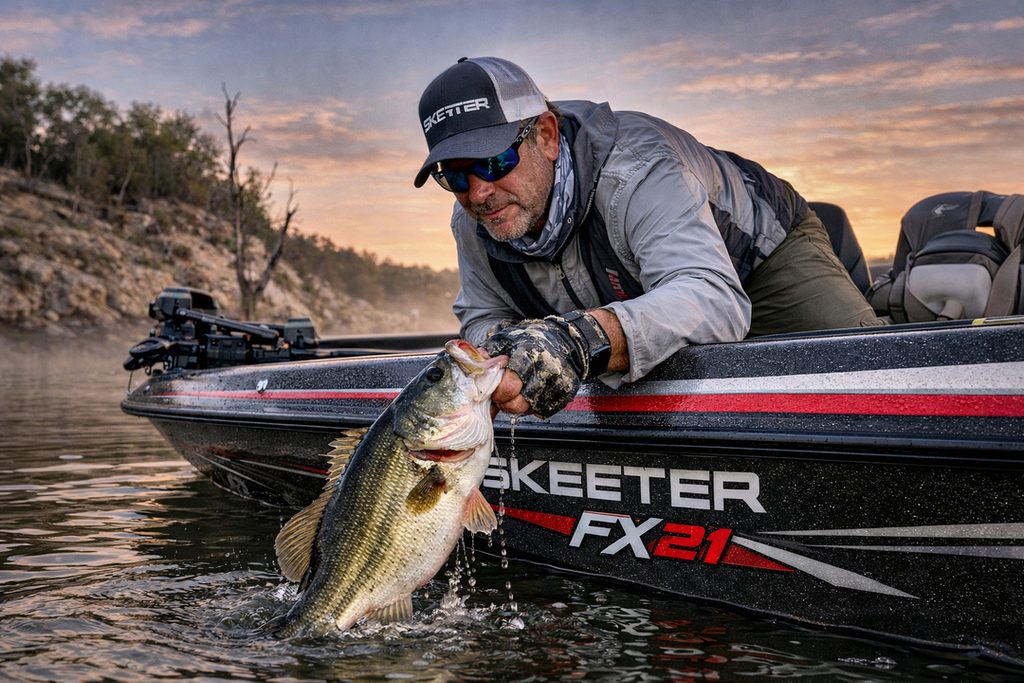
Anglers competing on Lake Fork carry a direct responsibility to practice exceptional fish care. Utilizing weighted livewell aerators, maintaining cool livewell water temperatures with ice during warm afternoons, employing non-piercing cull grips, and deploying livewell additives prevent delayed mortality. By pairing tactical offshore expertise and boat lane vigilance with dedicated conservation stewardship, anglers ensure that Lake Fork remains Texas’s undisputed crown jewel of trophy bass fishing for decades to come.